
Why Static Reorder Points Are Failing Liquor Stores
Why Static Reorder Points Are Failing Liquor Stores — And What to Do Instead
For decades, liquor stores have relied on static reorder points: “When inventory hits X, reorder Y.” It’s simple, predictable—and increasingly ineffective.
In today’s environment, where customer demand shifts quickly and supply chains are anything but consistent, static reorder points are leaving money on the table and shelves either overstocked or empty.
Let’s break down why.
The Problem with Static Reorder Points
Static reorder points assume:
Sales are consistent
Lead times are predictable
Demand doesn’t fluctuate
None of those are true anymore.
A product that sold 2 cases per week last month might suddenly sell 6 because of:
Seasonal demand
Local events
Pricing changes
Competitor stockouts
Meanwhile, delivery timelines can stretch unexpectedly. A “1-week reorder cycle” can easily become 2–3 weeks.
Static systems don’t react. They lag. And that lag costs you:
Lost sales (out-of-stocks)
Tied-up cash (overstocking slow movers)
The Shift: Dynamic Reorder Points
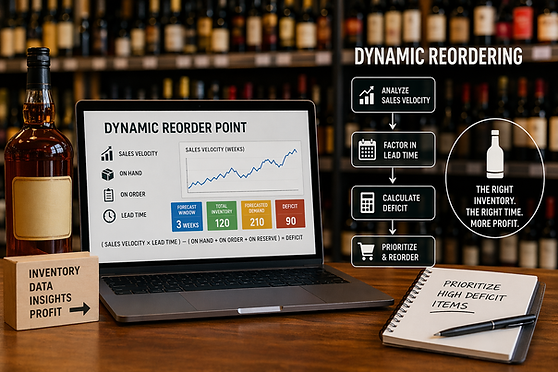
The smarter approach is dynamic reordering—inventory decisions that adapt in real time based on what’s actually happening in your store.
At its core, a dynamic reorder point answers one question:
“How much will I sell before my next order arrives?”
To answer that, you need three key inputs:
Sales Velocity:
How fast is the item selling right now?
Inventory Position:
What do you actually have?
On hand
On order (incoming)
Lead Time (Delivery/Shipping Delay)
How long will it take to receive your next order?
Forecasting Based on Reality
Instead of guessing, you forecast based on your lead time.
If your supplier delivers in 1 week → forecast 1 week of sales
If delays stretch to 3 weeks → forecast 3 weeks of sales
This is critical.
If it takes 3 weeks to restock, but you’re only planning for 1 week of demand, you will run out.
The Formula That Actually Works
Once you know your forecast window:
Forecasted Demand (based on sales velocity × lead time) – Total Inventory (on hand + on order + reserved) = Deficit
That deficit is what you need to reorder.
No guessing. No static thresholds. Just math based on real movement.
Capital Allocation: Where Most Stores Get It Wrong
Here’s where things get even more important.
Most stores don’t have unlimited cash—they operate on a weekly purchasing budget.
So the question becomes:
“Which items should I prioritize?”
With a dynamic system, you can:
Identify which SKUs have the largest deficits
See which products are most at risk of stocking out
Allocate your budget toward high-velocity, high-impact items first
Instead of spreading your money evenly—or worse, emotionally—you’re deploying capital where it drives the most return.
The Bottom Line
Static reorder points are outdated because they ignore reality.
Liquor stores today need:
Real-time sales awareness
Accurate inventory visibility
Lead-time-based forecasting
Intelligent capital allocation
When you combine those, you don’t just “manage inventory”—you optimize it.
And that’s the difference between:
reacting to problems
vs.
staying ahead of them
Liquor Bee is built around this exact philosophy—helping stores move from static guesswork to dynamic, data-driven decisions.
Because the stores that win aren’t the ones with the most inventory…
They’re the ones with the right inventory.


Comments